Documentation
- Administrator
- Student
Cookie choices and privacy
Privacy
eMedhaa shows a cookie consent experience on the public site and student portal so visitors can control optional tracking and features. This page explains what users see and what institute staff should configure.
What visitors experience
On the first visit (when no choice is stored), a modal titled Your privacy choices explains:
- Essential cookies always run (sign-in, security, basic operation).
- Optional cookies support analytics and functional features such as social sign-in.
Actions:
- Reject non-essential: only necessary cookies.
- Accept all: allow analytics and functional cookies per your enabled integrations.
- Cookie settings: granular toggles for Functional and Analytics.
The Privacy policy link opens in a new browser tab. A cookie icon on the page reopens settings later.
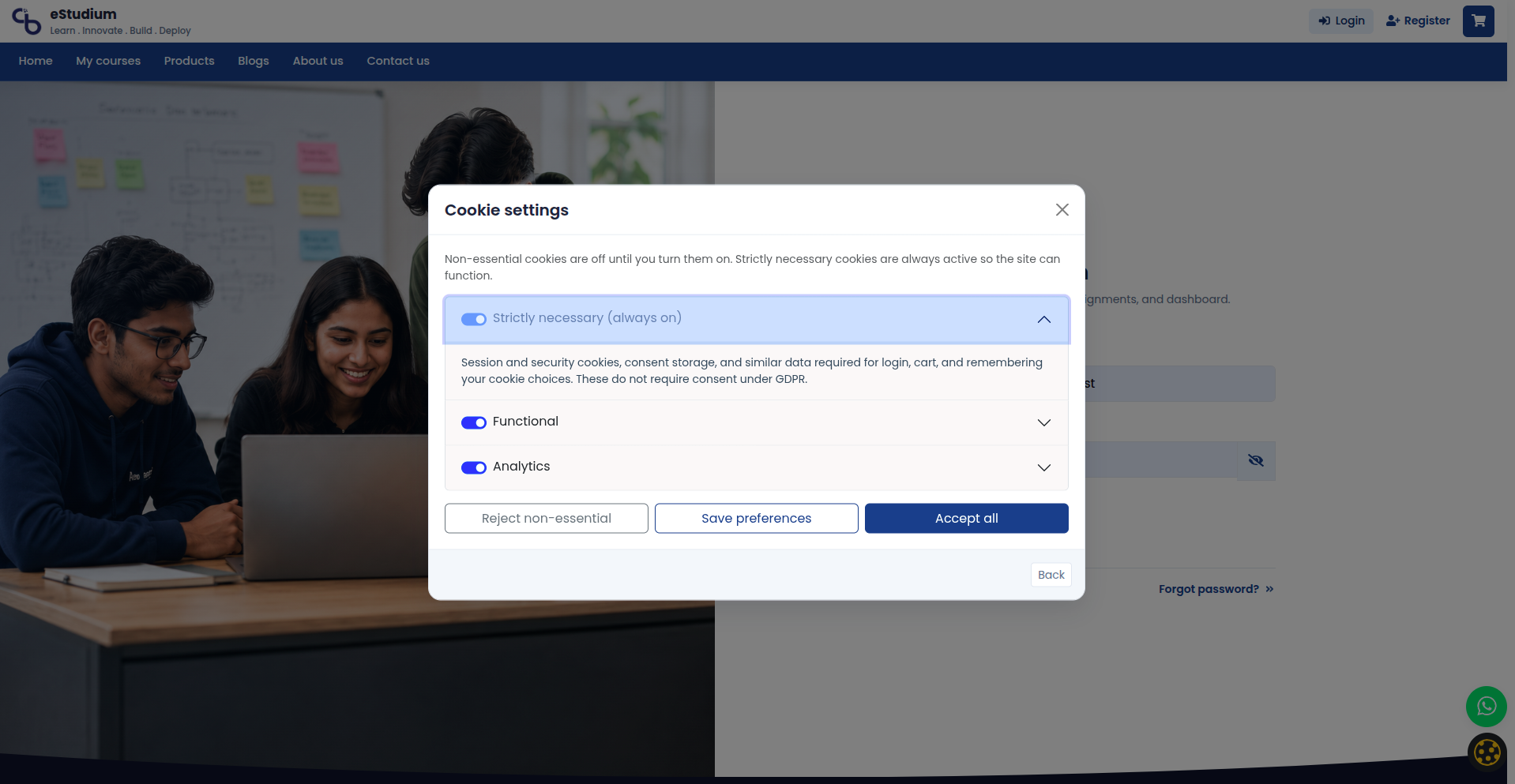
Categories explained (for your privacy policy)
- Necessary: Session, authentication
- Functional: OAuth state for Google/Facebook login
- Analytics: Google Analytics (if enabled)
Administrator responsibilities
- Maintain accurate Privacy policy text under Site content.
- List third parties: Google Analytics, Google/Facebook login, payment gateways, video providers, WhatsApp.
- Enable Google Analytics and social login only when legally and contractually allowed.
- Train staff not to embed third-party trackers in rich text without review.
Google Analytics interaction
Analytics loads only when:
- An administrator enabled it under Site header, and
- The visitor consented to analytics (or accepted all).
See Google Analytics.
Social login interaction
Google and Facebook sign-in expect functional consent. Visitors who reject non-essential cookies may need to use email/password instead.
See Social login.
Logged-in users
When students or staff are signed in, consent preferences may sync to the server so choices persist across devices (subject to your deployment).
FAQ
Do cookies affect course access?
Can we hide the banner?
Where is policy content edited?
What you gain
- Transparent defaults aligned with common GDPR-style expectations
- Reduced risk of loading trackers without consent
- Clear student-facing language you can mirror in legal pages